Coffee Maker

Getting It Straight From the Horse’s Mouth
Here’s an interesting graphic. It is basically saying that people searching for Bernie Sanders on Google end up clicking through to his official website more often than searchers for any other candidate. Searches relating to Sanders end up on his official site 4% of the time. The next closest is Trump, but he is far behind Sanders – searches about Trump only end up on his web site about half as often, or 2.3% of the time.
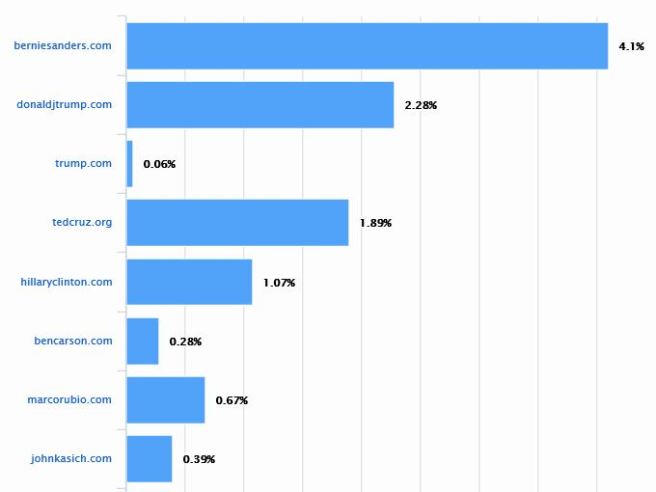
Why do more of the people interested in Bernie Sanders follow through and actually go to his website?
Maybe they can’t find enough info in the press so they have to go to his website to see what he is up to. Or maybe they are more wonkish, and actually care to read his positions on various issues. (But that would imply that Trump’s supporters are the second most wonkish. Hmm..)
Maybe they want to donate to him and find his site through Google. Sanders gets a high proportion of his funds through small donations.
It is probably a combination of these and other factors. In any event, you’ve gotta feel for some of the other candidates. They spent a lot of money on their web sites but they don’t seem to be getting much use.
The graphic, BTW, is from this site, a company that is analyzing search behavior.
Paul Ryan Is 3 Out Of 5
By his own yardstick, Paul Ryan is over halfway there to getting the Republican nomination for president. When he fake non-ran for Speaker of House, he denied he was running or interested in the job 5 times before he finally accepted the will of the party and took the job.
As of mid April 2016, he has already denied running for president three times:
- Oct 30, 2015 to CNN
- March 16, 2016 to CNBC
- April 12, 2016 in a news conference
The convention is not until July, so there is plenty of time for two more Paul Ryan denials.
Cleanup on Aisle 7
This is either very effective marketing or a very ineffective freezer case

2016 Winners and Losers v1
Who are the winners and losers in the 2016 presidential race?
As of early April 2016, here’s what we see
Winners
Trump: No matter what happens, he has already won hugely. He just put another few billion dollars onto the value of his brand.
Cruz: His peers think he’s a jerk, but they’re holding their noses and lining up behind him to stop Trump. Talk about being in the right place at the right time.
Kasich: Who ever thunk he’d still be around? Maybe he even becomes the new poster child of moderate Republicans
Bernie: Yeah it’s Quixotic, but hey, he’s having big time influence. Besides, who else is gonna mobilize the angry Democrats?
Carson: Should have a nice future on the lecture circuit
Losers
Bush: Wow, that didn’t take long. Complete flame out. The good news is that Pops and Mummsy don’t have to keep watching him get skewered for another six months.
Rubio: At least he hung around longer than Bush. But what a tanking in Florida. Is he starting to regret leaving the Senate?
Carly: Maybe she should try to run for an office that she can actually win, like school board.
The Trumpinator
Why hasn’t there been much ink spilled on the parallels between Donald Trump and Arnold Schwarzenegger?
Both of these guys came out of the celebrity word to upend politics. Make no mistake, Donald Trump has not been in the real estate business for years. Ever since he started putting his name on buildings he has been in the celebrity business. By his own reckoning, the vast majority of his $10 billion in wealth is related to the brand he has created: Trump.
The best – and really only – way to keep that brand valuable is to be famous. Trump has been working at this since the 1980s and has over 30 years of experience in working the press. How many times has he been in the NY Post’s Page 6 celebrity column? He was regularly featured in Spy magazine 25 years ago. He has been honing his celebrity status and his interactions with the press before most of the folks covering him were out of grade school.
Arnold also spent a lot of time and effort crafting his celebrity status. When he declared for the governor of California, the political press were blindsided. The celebrity press in LA had his number but they were no longer on the story. To the political press, he was celebrity royalty who all of the sudden deigned them access.And Arnold knew how to work it. By they time the political press got their feet back on the ground, Arnold was the Governator.
Is the Trump situation similar? The celebrity press would know when to give him ink and when to ignore him. The political press has no clue. Trump says something and the more outlandish it is is the quicker they are to give him some ink. They are thinking to themselves, “Wow. This stuff is great. All of the other politicians are so carefully crafted and the stuff out of Trump’s mouth will get my story on the front page for sure.” Do you think Trump doesn’t know this? He works it just like Arnold did.
The only difference is the timing. Arnold declared 8 weeks before the election (it was a special recall election). Trump has to keep the political press off balance almost 10 times as long. If he can do it, how do you like the sound of Kongresswoman Kardashian?.
What’s Uber Uber?
Whatever you think of Uber and Lyft and similar companies, the industry they attacked pretty much had it coming. Not the cabbies themselves, but the medallion owners and cab companies. The taxi business is a poster child for an ossified industry that has not changed much over the years and made minimal use of technology. How long could it really get away with that and not get targeted by the ‘new economy’?
There were a couple of factors that set this industry up for disruption.
Taxis need a license or ‘medallion’ to cruise the streets legally. Because the number of medallions is tightly controlled and limited, they cost way more than the average driver can afford. In most cities, medallions are disproportionately concentrated in the hands of a small group of owners, many of whom are investors with no connection to the industry. Taxi drivers earn a living, but just barely. The return on their labor is much less than the return on the capital used to purchase the medallions.
One big reason is because the government regulates the industry. There are various types of regulation. Some is to keep us safe such as background checks on drivers and inspections of the vehicle mechanicals. But some is intended to manipulate commerce, i.e., limiting the number of medallions available.
I am not making the argument that regulation is good or bad, but I will say this: generally, when a government tries to regulate commerce in an economy with a free market system, the free market system wins. Maybe not at first, but eventually the system finds a way around the government’s efforts to control supply and demand and/or prices.
So if you were looking for an opportunity where the government was regulating commerce, the economic benefit was concentrated in a select few and the people actually working in the system really were not making out all that well from the current set up, wouldn’t the taxi industry pop up on your radar?
The ride sharing companies win.
Until the next big disruption.
Which could be sooner than you think.
When driverless cars come along won’t you just be summoning one of them instead of a human driver? So the folks that are driving for Uber, what have they got? 5 years? 10 years at the most before the next disrupter hits?
At this point the industry really will be more like AirBnB. With AirBnB, you own the capital (a piece of property) and you rent it out. You may have to pay someone to clean it out after the rental, but otherwise it is a pretty straightforward deal: you rent your asset to someone else. Won’t it be the same in the driverless car world? You own a car that has driverless functionality and put it up on AirCarnCar and someone rents it? It leaves your garage automatically, drives over to the bar and gives someone a ride home. Then it either stays out ready for another fare or comes home to your garage for the evening. Maybe you program it to stop at the all night car cleaners before it comes home so it is all fresh for you to commute to work in the next morning.
What will all the drivers do for income at that point? Hope they don’t invest their retirement money in Uber stock.
The new realities
Here’s what I want to know about the new realities, virtual and augmented. Particularly augmented. If I have one of these headsets, why would I bother taking up a wall of my living room with a large television? I could put this headset on, wave my fingers around and viola! virtual 90 inch television wherever I want it.
If there were several of us watching there would never be a fight over the remote. We could all sit in the same room and watch the same or different shows together, skip back and forth DVR style, etc. One of us could be watching split screen, the other with subtitles.
Meanwhile TV technology gets cheaper and better. But is it doomed? Do TV’s go the way of stereo systems? Who has a high quality stereo anymore? Everyone listens to music on earbuds or a Bluetooth speaker. The sound is OK, but nothing like a high end audio system. Still, no one seems to care.
Maybe TV technology ends up being re-purposed to more of a background player vs. the focus of our attention. Framed, a TV could be art that changes depending on the mood it senses from your wearable. Or you build one into your room to get a window where a physical one is impossible, like on an inside wall. A camera outside and a large TV on the wall would give you a real time ‘window’ wherever you wanted one.
Where’s my phone?
Friend just asked me to call her phone because she could not find it. We heard it ringing. She spent a few minutes walking from room to room before realizing it was in her pocket. And so it goes . . .
 Rantastic